
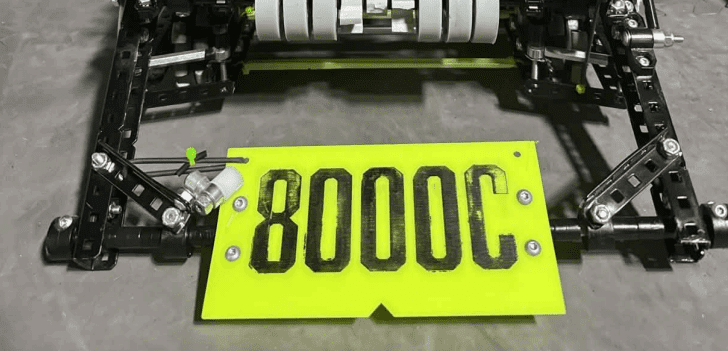
8000C: Rebuilding the 8K Legacy
As of this point in the season, Team 8000C – Chain Reaction holds an RFORCE of 63.31, ranking them 575th globally in VEX V5, and 73rd in California (47th among HS). They have attended 12 events so far and earned 2 awards this season, steadily building momentum with each competition and their qualification to the State Championship.
I had the opportunity to see that momentum firsthand on February 21st at the Bay Area Pushback Tournament #6 in East Palo Alto, California. Watching them compete in-person added context to the numbers. The statistics alone show their growth throughout the season, but their live performance in matches show their true identity as a team.
8000C is not a new name in VEX Robotics. The team has existed since the 2013–14 Toss Up season, part of the Head-Royce School in Oakland, an organization with over 15 years of competitive robotics history in VEX. Over the years, 8K teams have captured State Championship awards before, even reaching the Finals at the World Championship. But history alone does not win matches, and the 2025-26 team has a strong legacy to uphold.
This season, almost the entire roster is new to 8000C. Only one returning member remained. Roles had to be reassigned. Strengths had to be rediscovered. Chemistry had to be rebuilt from the ground up.
Their most difficult moment this season was not mechanical, it was structural.
They had to figure out how they functioned as a team. Who leads, who builds, who codes, and who documents. Through that process, they learned that communication and patience are not just soft skills in robotics, but actual competitive advantages.
The internal breakthrough came earlier this season at Rumble in the Rockies Signature Event in Salt Lake City, Utah; their biggest and most difficult tournament so far this season, with 51 teams and an RFORCE Event Rating of 3.42. At that signature event, they were handed what they described as a “horrific schedule,” including tough opponent matchups and multiple 2v1 situations. Expectations projected a 3-5 record that day…
But they exceeded it.
Through a combination of a functioning robot, creative strategy, and high-level driving, 8000C clinched the #11 spot in qualifications among some of the best teams in the nation, proving to themselves that they could compete at a high tier.
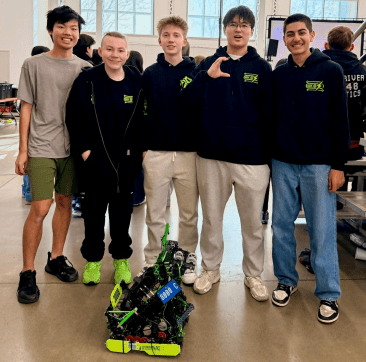
Their preparation throughout the season reflects this competitive drive.
For Skills, they rely on mass repetition. Driver runs are drilled until routes are locked in. Autonomous is tuned through detailed, repeated testing. Precision is engineered to perform in as many different scenarios and iterations accounted for as possible.
For matches, they sit down as a drive team, break down the game, create scenario-based strategies, then scrimmage with sister and cousin teams to simulate real match conditions. They drill specific maneuvers. In Push Back, wing play became a deliberate, practiced weapon.
Long term, their goal is clear. They want to restore the 8000 organization to its former dominance and return to the finals arena at VEX Worlds. As sophomores in high school, they know time is on their side. Patience and deliberate focus gives 8000C the confidence that they have what it takes.
Coaches: Forming Passion Before Competition
Behind 8000C are coaches Dr. Bryan Jennewein, Dr. Roy Nyberg, and Mr. Juan Fuentes.
Their philosophy is simple but powerful. They aim to form passionate STEM students before forming competitors. Competition is not the purpose. It is the expression of the passion they cultivate.
They want students who compete with respect and dignity while embracing the intensity that makes robotics electrifying.
In the times when they did step in this season, it has been to ensure teams had the tools and parts they needed, and to push for stronger communication across sub-teams. Resetting the team did not mean lowering standards. It meant reinforcing structure.
After graduation, they hope their students carry pride in the late nights, in the rebuilds, in the solving of problems together; a pride that pushes them to pursue STEM even beyond high school.
The Athletes: Responsibilities at Every Level of the Game
8000C is layered with responsibility.
Finn Hogan, a first-year builder, had to catch up quickly despite joining as a sophomore. He approaches problems slowly and creatively, allowing him to think outside the box. As a builder, he feels personal responsibility because the parts he builds are on the field at all times. When everything works well during a match, he feels pride not just in himself but in the entire drive team.
Tristan Choudhury, notebook lead and drive coach, faced intense pressure when he had to rebuild the entire team notebook in just days to strengthen their award chances at an upcoming event. Creativity is his edge when facing this time pressure. He firmly believes that if the notebook falls behind, the whole team falls behind.
Luke Peterson documents meticulously every improvement and autonomous update. In competitions, he does all the little things: replacing batteries, checking for loose parts, changing name plates, etc. They may seem small but allow his team to keep their flow. Losing in the finals after an undefeated qualification run was difficult, strengthened his determination for the season.
Tres Fregosa, driver and team lead, preaches “practice makes practice” in everything he does. Tough schedules and 2v1 matches have tested him repeatedly this season. But with over 150 matches of driving experience and three robot iterations behind him, he has internalized the idea that relentless practice produces results. Even when everything works, he stays locked into strategy rather than celebrating early, and analyzes every possible scenario.
Oscar Kozlowicz, lead builder, managed 3 full rebuilds while preparing for major events, often having to stay up late nights to do so. Not only does he overlook most building operations, but he also spends deliberate time teaching the other builders on the team. On top of that, he also protects team morale, reminding everyone to keep a positive mindset even in tough moments, and that one match does not define them.
Benjamin Huang, main programmer, engineered a custom CTemplate that gave the team flexibility beyond standard coding frameworks, and allowed his teammates to work even while he was away. Coordination between hardware and software teams was a major challenge, but strict planning and prioritized task lists fixed it. Robotics has taught him so much, including leadership, delegation, and alliance negotiation. As the season progresses, he continues to look for improvements in the code, even if small, as things can never truly work “perfectly” in his mind.
Tate Larson, programmer, often spends late nights tuning autonomous routines until movements align as accurately as possible. He values collaboration, knowing that a second opinion often unlocks solutions that would otherwise take much to rise. When the autonomous executes near flawlessly, he feels a deep sense of satisfaction.
Eric Guo, team lead and builder, carried the responsibility of organizing roles early in the season. As the only junior, he guided younger members and reinforced communication across the team. When everything clicks in a match, he sees not just a functioning robot, but growth in leadership and unity.
8000C has had their challenges in communication, and faced issues throughout the season, but a deeper dive into their practices reveals they are a model team. Every member brings something valuable to the table and shares accountability with the project as a whole.
The Robot: Simple. Adaptive. Fierce.
Their robot can be described in three words: simple, adaptive, and fierce.
The defining breakthrough came during their third iteration. Originally, a triple-state storage mechanism limited their capacity and slowed their ability to switch between scoring and defending. They then redesigned the intake into a split system that allows blocks to be held instantly by halting a motor.
Adaptability increased overnight.
Earlier in the season, their second iteration chassis cracked mid-match after a cross-bracing failure. It was a painful lesson in durability, especially in a defense-heavy game. That failure shaped their newest design, which now prioritizes strength, friction management, and resilience.
On the field, the robot reflects Tres’s aggressive driving style. The chassis allows controlled drifting for speed. Scoring mechanisms are optimized for rapid cycles to reduce de-scoring risk. The wing and de-score systems are built to withstand heavy contact. This machine is built to attack every aspect of the game with efficiency and adaptability.
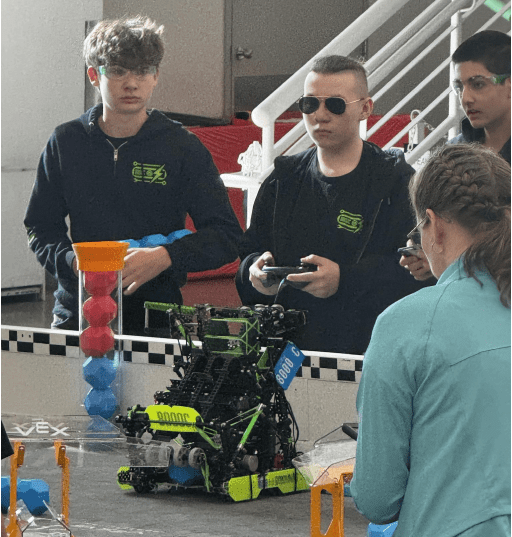
In one bold sentence, 8000C stands for getting better everyday, and rebuilding the 8K legacy through hard work and dedication.
And now the season continues… Stay tuned to the RFORCE rankings to see how these competitors from Oakland perform.
Brought to you by the RFORCE Editorial Team.
For the dreamers, the builders, and the next generation of innovators.